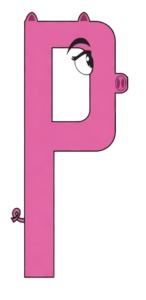
Every parent knows the drill: flashcards, repetition, “what letter is this?” again and again. Every parent knows the frustration when it just doesn’t seem to stick. The problem isn’t the child. It’s that many phonics lessons ask a young child to memorize an abstract squiggle with nothing to hang it on.
Letters aren’t naturally meaningful to a two- or three-year-old. A “P” is just a shape until it becomes something a child can see, hear, and feel in his or her own body. That’s where a visual, auditory, and kinesthetic approach, one that engages all three senses at once, changes everything.
The Three Types of Learning
A young child takes in the world through more than just his or her eyes. There are three main ways early learning happens:
- Visual – what a child sees and connects to images
- Auditory – what a child hears and repeats
- Kinesthetic – what a child does with his or her body
Most lessons lean toward using the visual and auditory modes of learning. When all three are used at the same time, a letter stops being an abstract mark and becomes an experience. That experience is what makes the letter stick.
How It Works in Practice
Here’s what that looks like in real teaching moments.
Each consonant is introduced first, followed by vowels with short and long sounds. Every letter comes with a visual clue drawn right into its shape. A “P,” for example, isn’t just a line and a curve. It becomes the body of Party Pig P, a character whose shape naturally matches the letter itself. That’s the visual piece in action.
From there, the sound comes in. The child recites the letter’s sound twice while looking at the picture, building the auditory connection before he or she ever tries to recall it alone.
Then comes the kinesthetic piece. The child acts out the letter while saying the character’s name, tying his or her whole body into the memory. Suddenly a child isn’t just looking at a “P.” He or she is seeing it, saying it, and moving it, visual, auditory, and kinesthetic, all working together at once.
Why It Sticks
This approach reflects a well-known principle in early reading: a child remembers best when new information connects to something he or she has already experienced. A letter only seen is easy to forget. A letter that’s been seen, spoken, and physically acted out is anchored in three different kinds of memory at once.
That’s why this approach doesn’t just teach the letters faster. It builds the kind of recall that lasts, because the child isn’t memorizing a symbol. He or she is encoding an experience.
A Method We Use Every Day
This blend of visual, auditory, and kinesthetic learning is at the heart of how we teach the alphabet in our program. Watching a child recite “Party Pig P” while acting it out, then recognize that same letter days later without hesitation, never gets old. It’s proof that when learning engages the whole child, the results really can feel like magic.